For many business owners, health insurance has become one of the fastest-growing expenses on the balance sheet.
Annual renewals continue to increase, employees expect better coverage, and small employers often feel like they have little negotiating power. It's not uncommon for businesses to see premium increases year after year despite having relatively healthy workforces.
This leads many executives to ask the same question:
"How are PEOs able to offer health insurance that's often more competitive than what we're buying on our own?"
The answer isn't that PEOs receive special discounts. It's that they purchase healthcare differently.
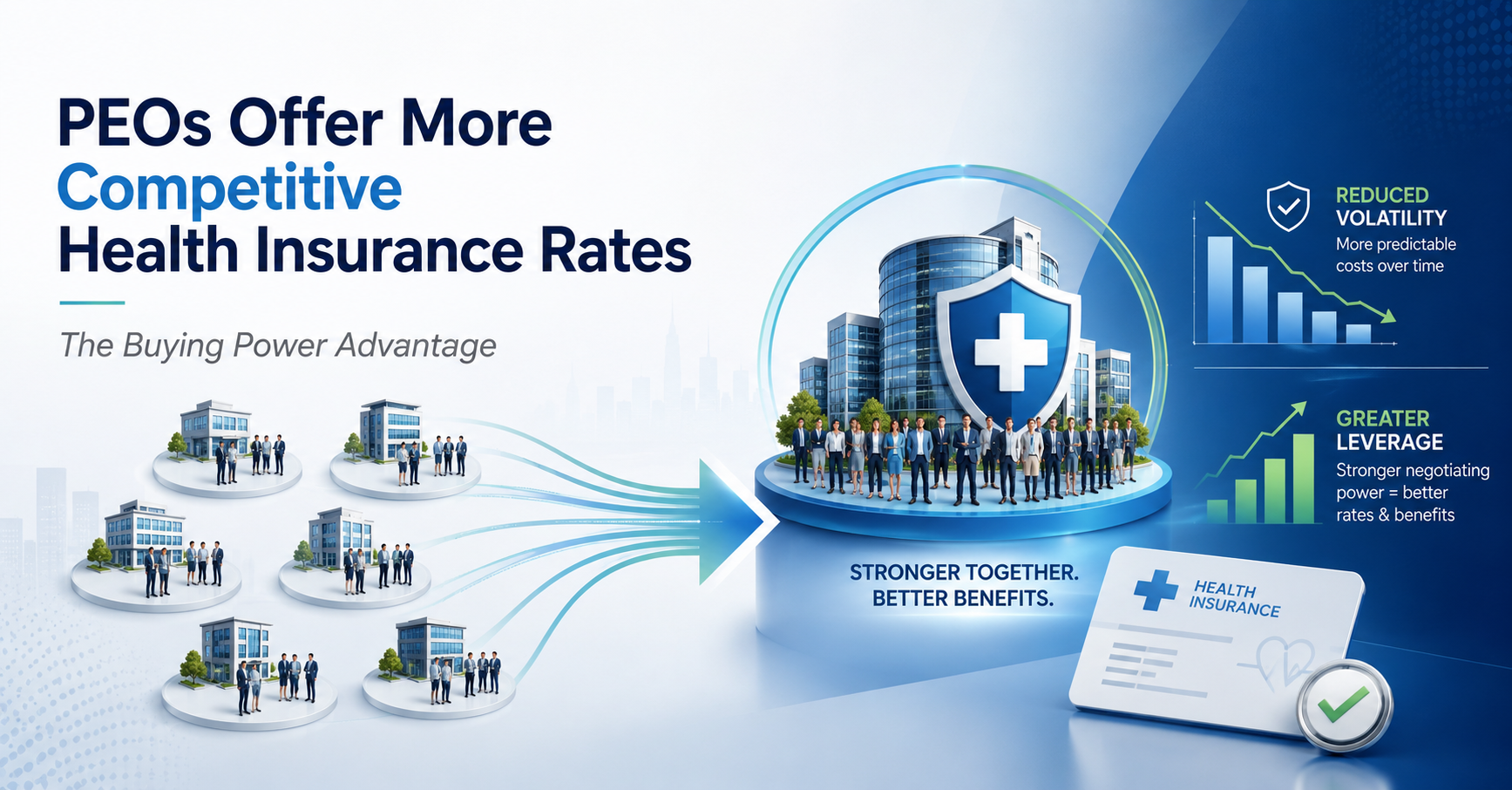
Larger Risk Pools Create Greater Buying Power
A business with 25 employees is typically rated as a small employer. Even a single high-cost medical claim can significantly impact future renewal rates.
A Professional Employer Organization (PEO), however, aggregates employees from hundreds or even thousands of client companies into one much larger group. Some of the nation's largest PEOs represent hundreds of thousands of worksite employees, creating purchasing power that individual employers simply cannot achieve on their own.
Larger risk pools generally create more predictable claims experience, which allows carriers to price plans more competitively and offer a wider variety of options.
Better Negotiating Power with Insurance Carriers
Insurance pricing is heavily influenced by scale.
Large employers have long benefited from stronger negotiating leverage because they bring more covered lives to the table.
PEOs extend that advantage to smaller businesses.
Instead of negotiating on behalf of one company with 40 employees, a PEO may negotiate for tens or even hundreds of thousands of covered employees. That increased leverage often results in:
More competitive premium pricing
Additional plan design options
Larger provider networks
Better ancillary benefits such as dental, vision, life, and disability coverage
While every renewal is unique, the purchasing power of a larger population creates opportunities that many standalone employers cannot access.
The Small Group Market Faces Greater Volatility
Small employers often experience significant renewal swings.
According to the Kaiser Family Foundation, the average annual premium for employer-sponsored family health coverage exceeded $25,000 in 2024, with employers paying the majority of that cost. Healthcare premiums have increased substantially over the past decade, placing continued pressure on employers to control labor expenses.
For smaller groups, one or two large claims can influence future renewals far more than they would within a much larger employee population.
That volatility makes budgeting difficult and creates uncertainty every renewal season.
Benefits Help Companies Compete for Talent
Competitive health insurance is no longer just an employee benefit.
It's a recruiting and retention strategy.
Research from the Society for Human Resource Management (SHRM) consistently finds that employer-sponsored health insurance ranks among the most valued employee benefits, often second only to compensation itself.
When businesses can offer stronger medical plans, they are often better positioned to:
Attract qualified candidates
Reduce employee turnover
Improve employee satisfaction
Compete against much larger employers
For growing companies, better benefits can become a competitive advantage without requiring Fortune 500 resources.
It's About More Than Premiums
While lower healthcare costs receive the most attention, many PEOs also integrate:
Payroll administration
HR support
Compliance guidance
Workers' compensation management
Employee onboarding
Benefits administration
Combining these services into one platform can reduce administrative work while simplifying day-to-day operations.
For many employers, the value comes from both cost savings and operational efficiency.
The Bottom Line
PEOs don't magically make healthcare less expensive.
They leverage scale.
By combining thousands of employees into larger purchasing groups, many PEOs are able to negotiate benefits that individual small and mid-sized businesses would struggle to obtain on their own.
For companies facing rising healthcare costs, comparing a traditional benefits renewal against a PEO proposal can provide valuable insight into what's available in today's market.
Even if a PEO isn't the right fit, understanding the alternatives can help ensure you're making the most informed decision for your business.
Email Sales@BACbenefits.com or call 321-441-9056 to see real-world examples of how we’ve helped insurance agents uncover strong PEO solutions for their clients. From lowering Workers’ Comp costs to improving Employee Benefits and streamlining HR administration, we help agencies turn difficult cases into valuable opportunities.