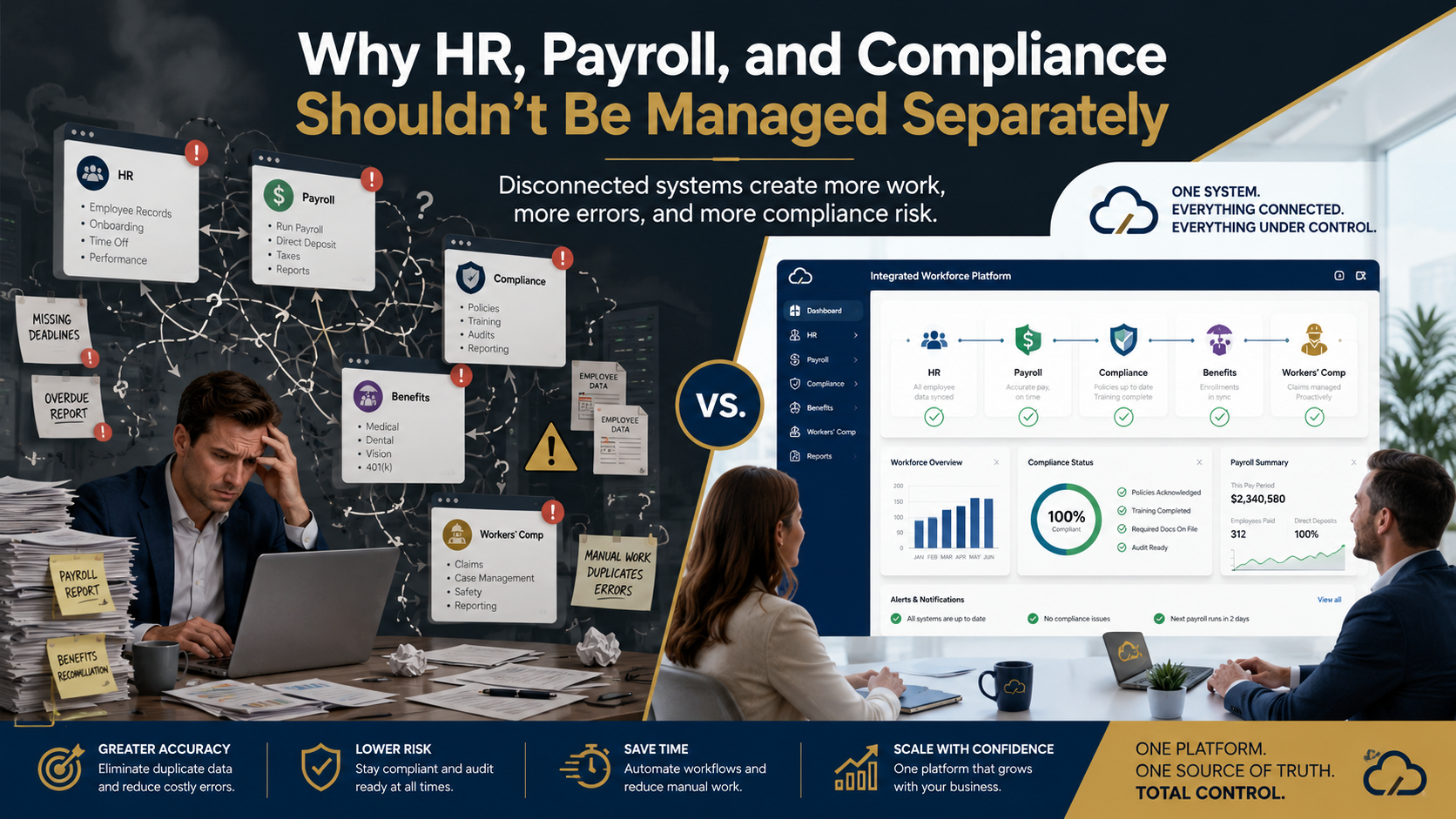
Many growing businesses manage HR, payroll, and compliance with separate systems, vendors, and processes.
At first, it seems practical.
Payroll runs through one provider. Benefits are handled by a broker. HR questions go to an office manager or outside consultant. Compliance issues are addressed only when something comes up.
But as a company grows, this disconnected approach creates inefficiency, confusion, and risk.
What starts as a workable setup often turns into a constant cycle of manual work, communication gaps, and costly mistakes.
The Problem With Separate Systems
HR, payroll, and compliance are deeply connected.
When those functions operate independently, information gets duplicated, missed, or delayed.
For example:
An employee changes benefits, but payroll deductions aren’t updated correctly
PTO balances don’t sync with payroll records
A terminated employee still has system access or active benefits
Employee classifications aren’t aligned between HR and payroll
These issues are more common than most companies realize.
Disconnected systems force employees to manually update information across multiple platforms, increasing the likelihood of errors.
Payroll Mistakes Become More Likely
Payroll depends on accurate HR data.
When onboarding, pay changes, benefits deductions, and employee classifications are handled separately, payroll errors increase.
And payroll mistakes don’t just create frustration. They can trigger:
Tax filing issues
Wage and hour disputes
Penalties and audits
Employee trust problems
As businesses grow, even small payroll inconsistencies can become expensive.
Compliance Gets Harder to Manage
Compliance is another area where disconnected systems create risk.
Employment laws continue to evolve, especially around:
Multi-state payroll
Overtime rules
Leave policies
Employee classifications
Workplace documentation
When HR and payroll aren’t aligned, compliance gaps appear quickly.
Many companies don’t realize there’s a problem until they face:
An employee complaint
A tax notice
A workers’ comp issue
Or an audit
At that point, fixing the issue is often much more expensive than preventing it.
Employees Notice the Difference
Disorganized systems also affect the employee experience.
Employees expect:
Accurate payroll
Easy onboarding
Clear communication
Fast issue resolution
Access to benefits information
When systems are fragmented, employees often experience delays, confusion, and inconsistent communication.
That frustration impacts morale and retention over time.
Why Integrated Systems Scale Better
Growing companies need operational infrastructure that works together.
This is one reason many employers move toward integrated HR models such as a Professional Employer Organization (PEO).
A PEO combines:
Payroll processing
Benefits administration
HR support
Compliance guidance
Workers’ comp management
Into one centralized system.
Instead of managing multiple vendors and disconnected platforms, companies gain one streamlined process with aligned data and support.
This reduces administrative work while improving accuracy and compliance oversight.
Better Visibility for Leadership
Another major advantage of integration is visibility.
When payroll, HR, and compliance data live in one place, leadership can better track:
Labor costs
Turnover trends
Benefits usage
Workers’ comp exposure
Hiring and growth metrics
That visibility supports smarter business decisions and better long-term planning.
The Bottom Line
Managing HR, payroll, and compliance separately may work for very small businesses, but it becomes increasingly inefficient as companies grow.
Disconnected systems create more manual work, more errors, and more compliance exposure.
Curious what you might be missing?
A short PEO cost analysis can show where savings and efficiencies really exist and whether a PEO is the right fit for your business. 📩 Email Sales@BACbenefits.com or call 321-441-9056 to schedule your free PEO cost analysis.